

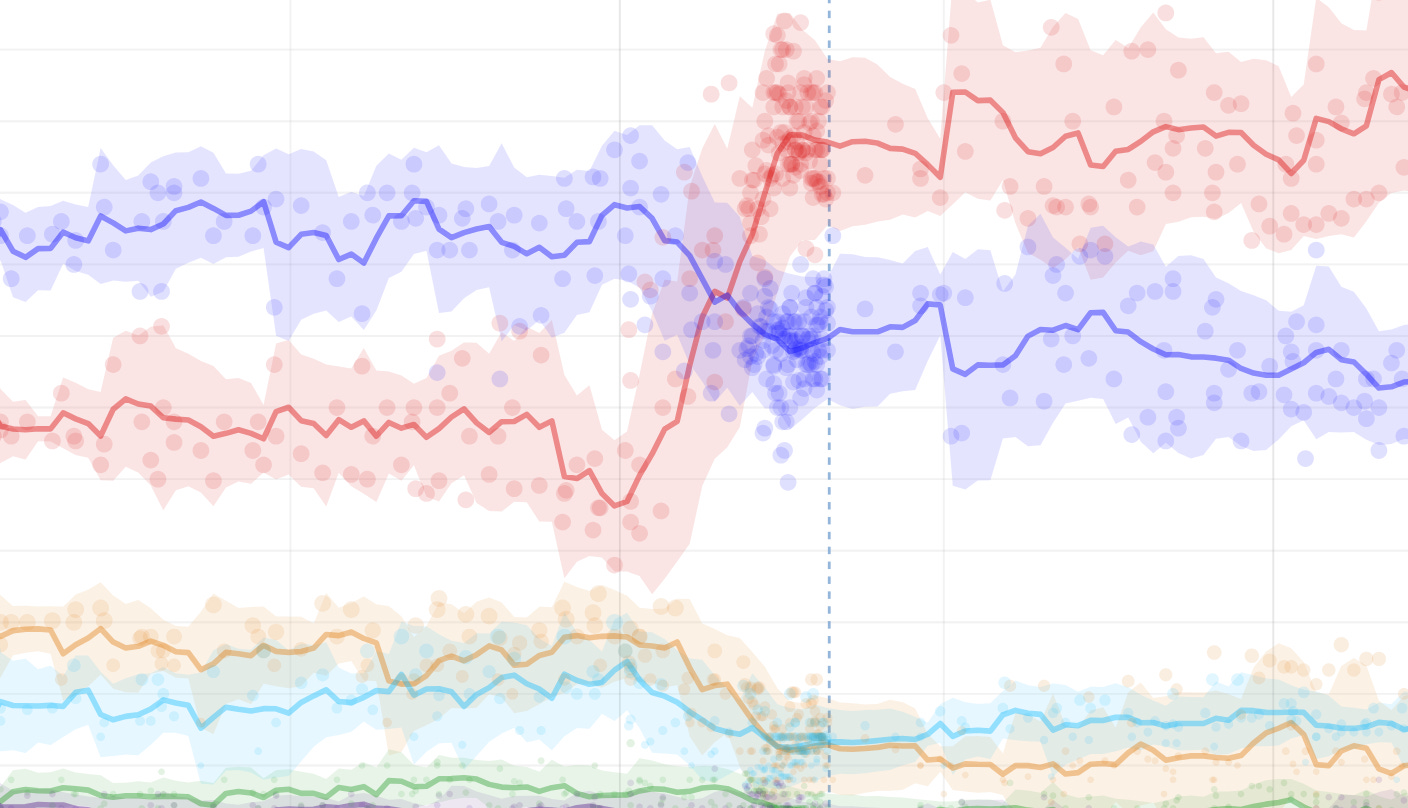
A new way to explore Canadian polling data is now live on 338Canada.
Many regular readers of this newsletter have already bookmarked this page listing all federal polls, but readers can now scroll and view rolling averages over time by gender and age group, as well as by region.
Regional numbers currently go back to shortly after the 2019 election, and the demographic data to shortly after the 2021 election. Older data will be added in the coming weeks and months.
The rolling averages by demographic group will be updated every Sunday, in sync with the 338 Sunday Update.
Naturally, demographic breakdowns are based on subsamples and therefore come with greater uncertainty and wider fluctuations. Nevertheless, these trackers offer a useful broad view of how the political landscape is evolving.
For instance, the trackers show that the 2025 Liberals — despite their sudden and sustained rise in support as Mark Carney took the reins of the party — did not overtake the Conservatives among male voters until after the 2025 election. At the end of the campaign, the Conservatives still held a three-point lead over the Liberals — technically a statistical tie, but a lead nonetheless.
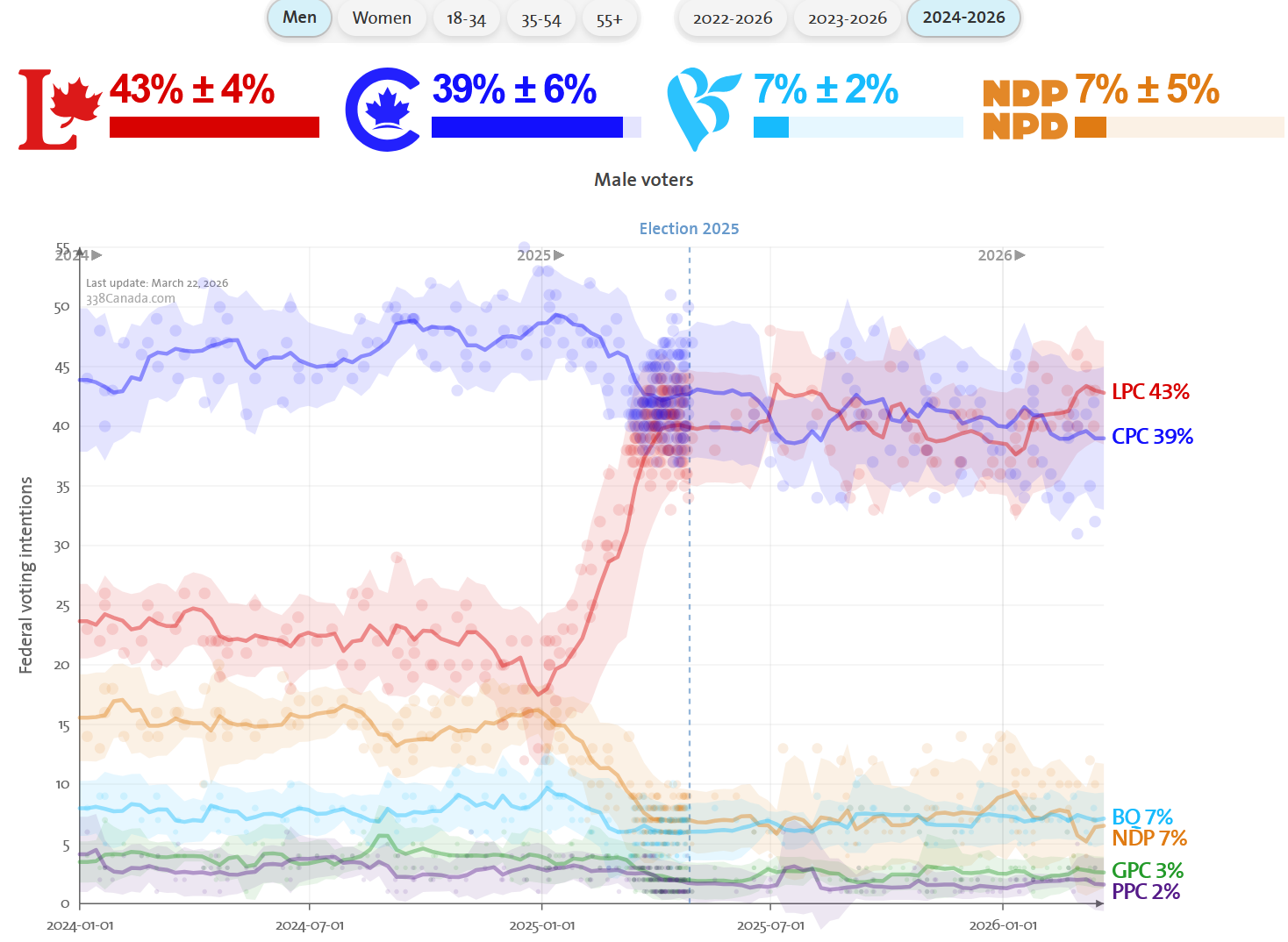
Carney has since made gains among men, and the latest update now shows the Liberals ahead by four points over the Conservatives — still within the margin of error, but a notable shift.
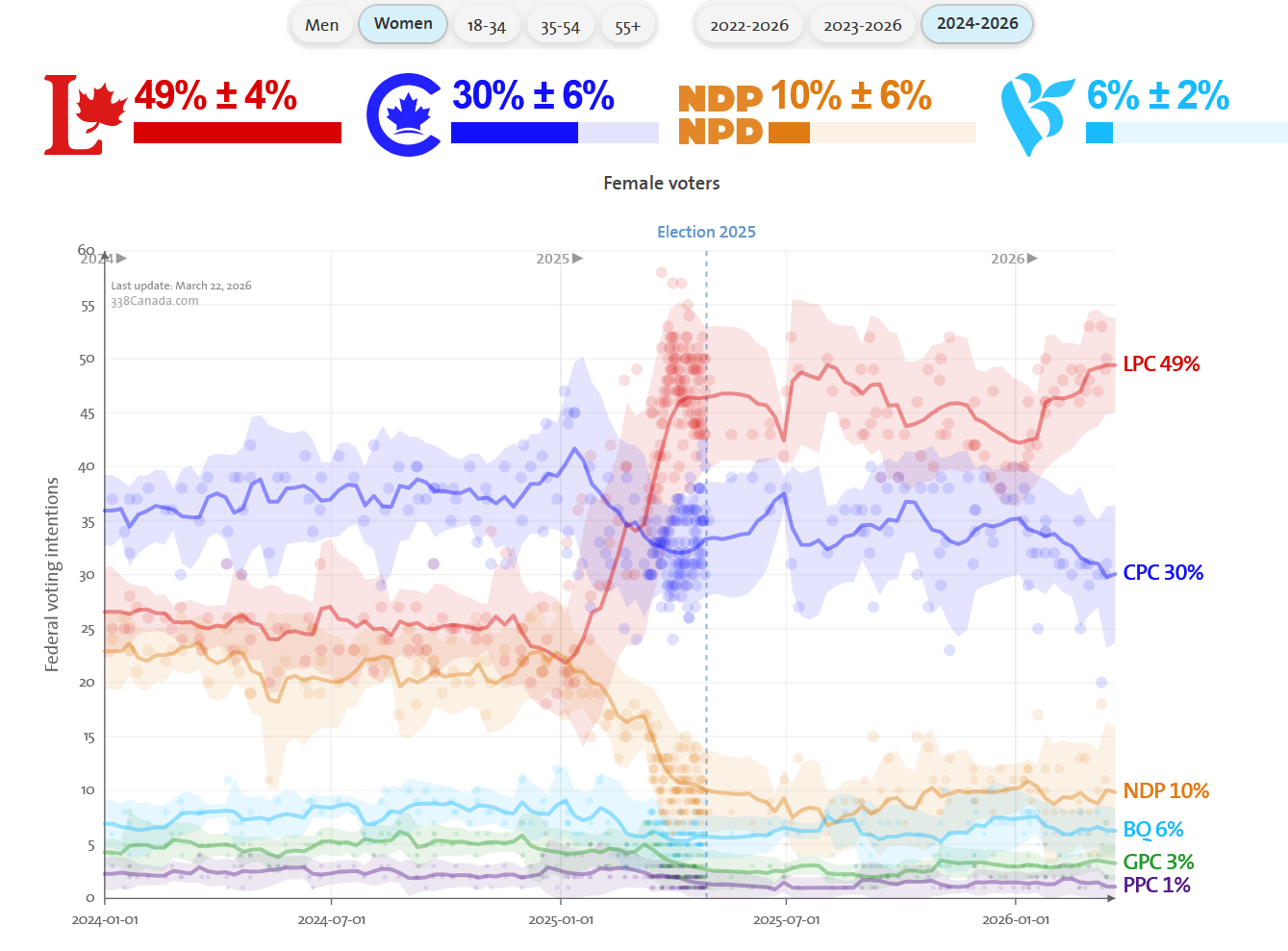
Among women voters, however, the Liberal advantage clearly exceeds the confidence interval: the tracker currently places the Liberals at 49% on average, compared to 30% for the Conservatives.
The age breakdowns are also revealing — for both obvious and less obvious reasons.
Obvious: the stark differences in party support across generations.
Less obvious: the difficulty of polling younger voters, as reflected in the larger fluctuations — and therefore wider confidence intervals.
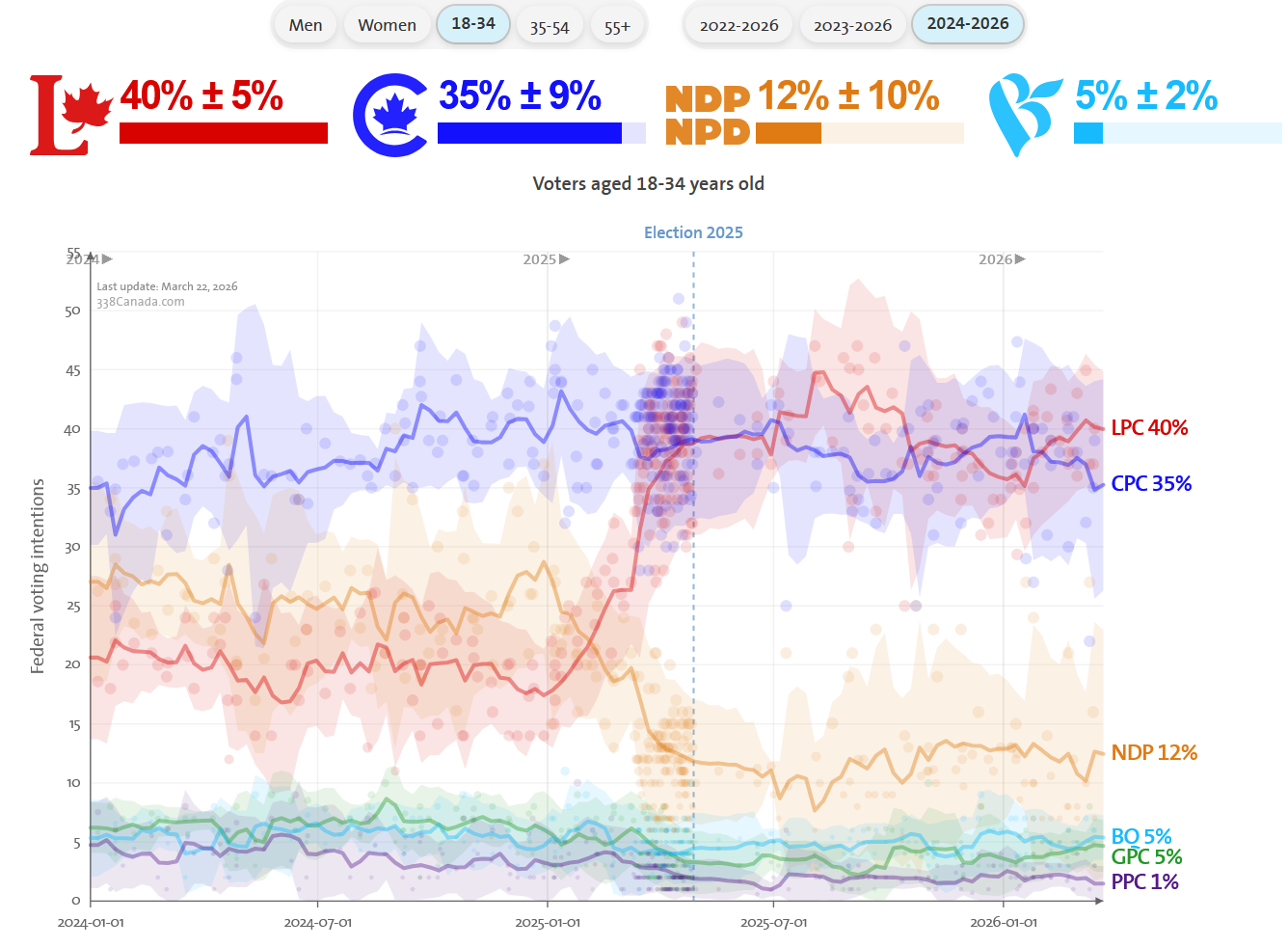
Among voters aged 18–34, the Liberals hold a five-point lead over the Conservatives (40% to 35%). However, the 95% confidence interval for the Conservatives stretches to ±9 points. The uncertainty is even greater for the NDP: 12% on average, with a confidence interval of ±11%. This is not a bug, but a feature — when results vary widely from poll to poll, the uncertainty grows accordingly.
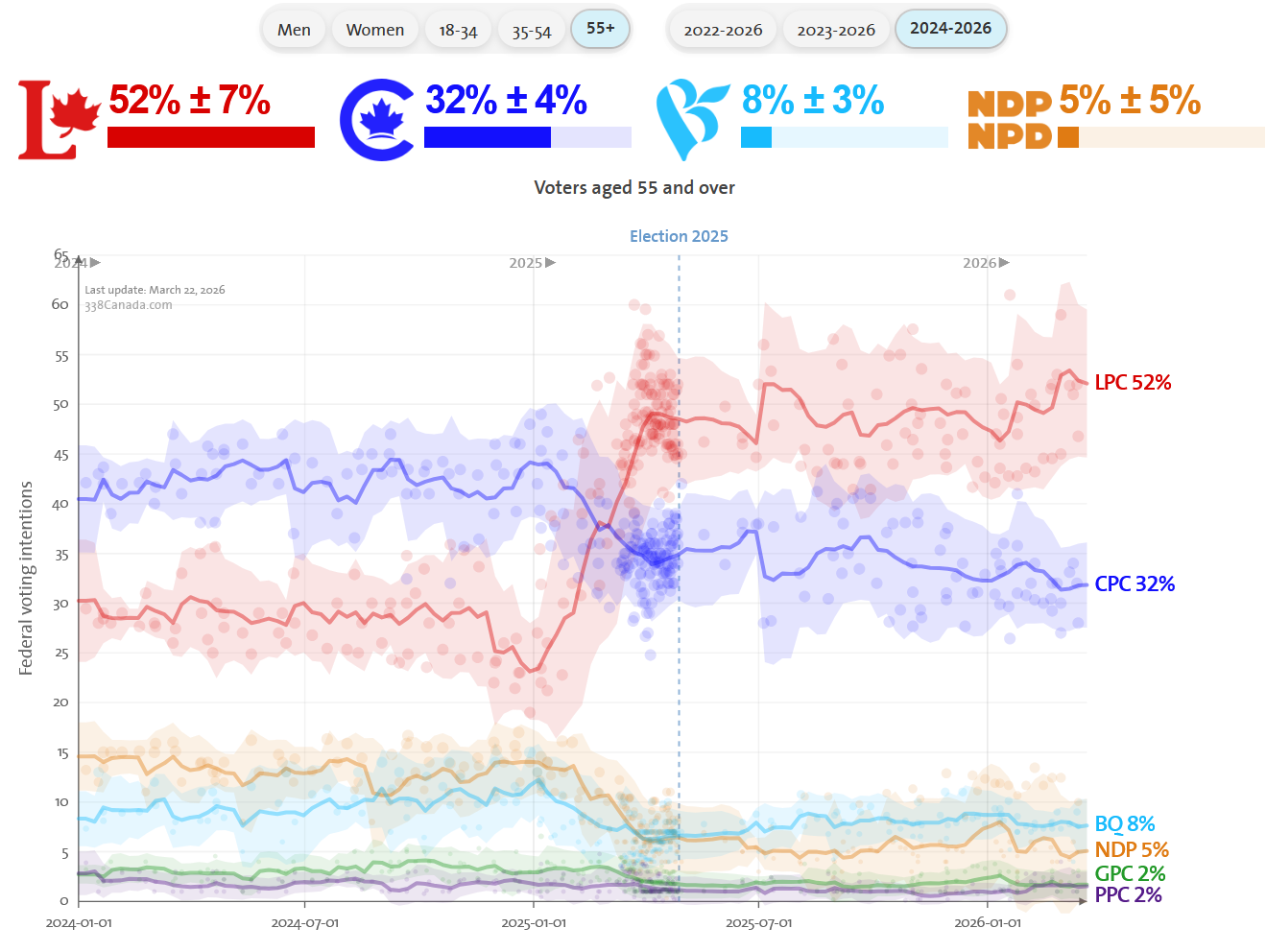
For comparison, consider voters aged 55 and over: confidence intervals are much tighter, with the Liberals at 52% ±7% and the Conservatives at 32% ±4%.
As for the NDP, the projection sits at 5% ±5% — a direct reflection of high variability across polls. For example, a recent Léger poll (fielded in early March) placed the NDP at just 2% among older voters, while Liaison Strategies still finds the party in double digits within that same group.
You can explore the 338 demographic tracker here. All national and regional polling data can be found here. Finally, the 338Canada government approval tracker is available here.
More to come this week. Thank you for supporting 338Canada. 🍁❤️
Thanks for the additional insights.