

Happy Sunday, dear 338Canada readers,
It was a busier week on the Hill than in the polls, with another floor crossing and a potential new vacancy on the horizon.
Let’s get to the polls first.
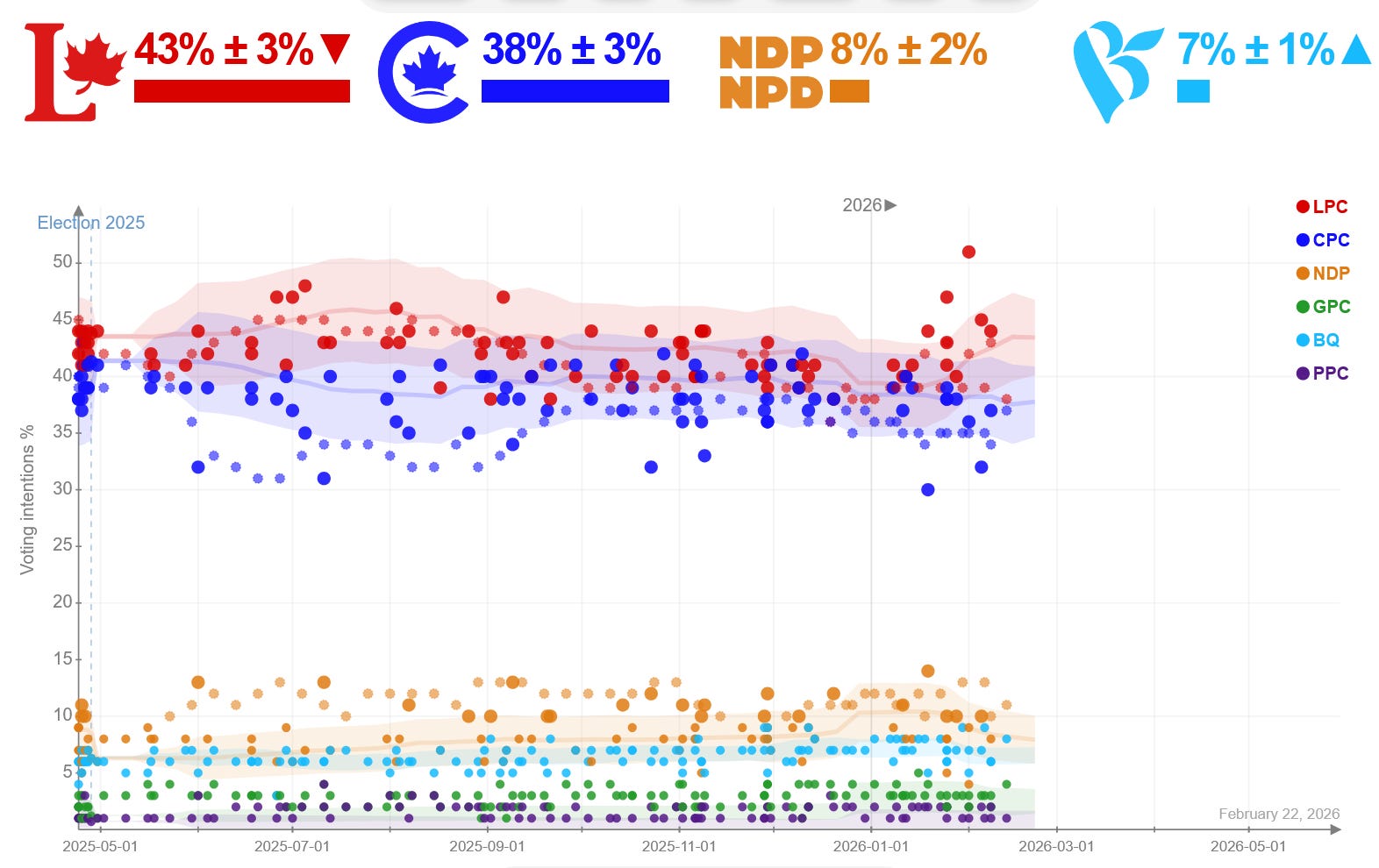
The two weekly trackers — Nanos Research (4-week tracker, 250 respondents per week) and Liaison Strategies (2-week tracker, 500 respondents per week) — moved in opposite directions last week, though in both cases the net movement remained well within their respective margins of error.
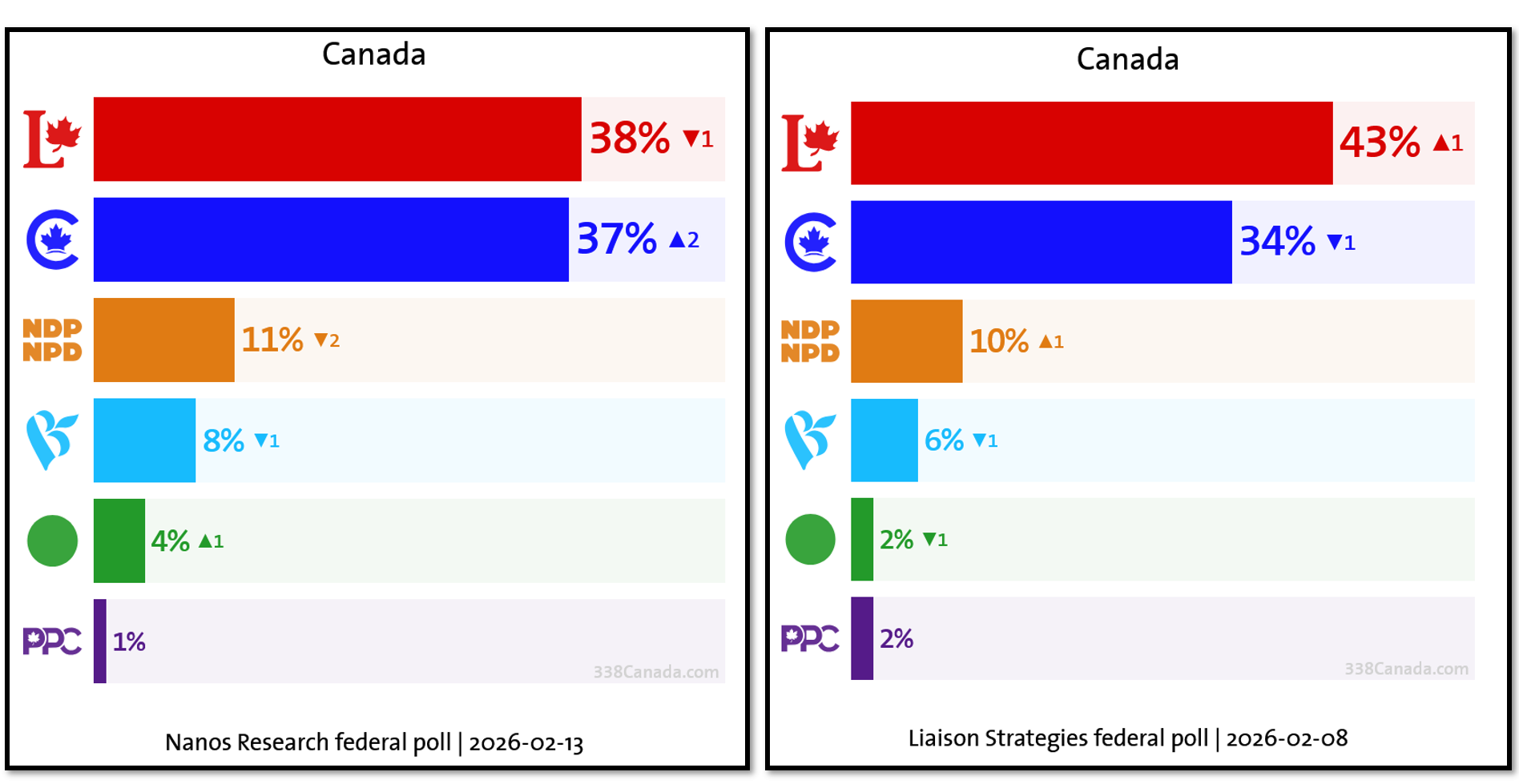
Liaison had the Liberals ahead by nine points over the Conservatives, 43% to 34%, while Nanos showed the gap narrowing, with the Liberals edging the Conservatives 38% to 37%.
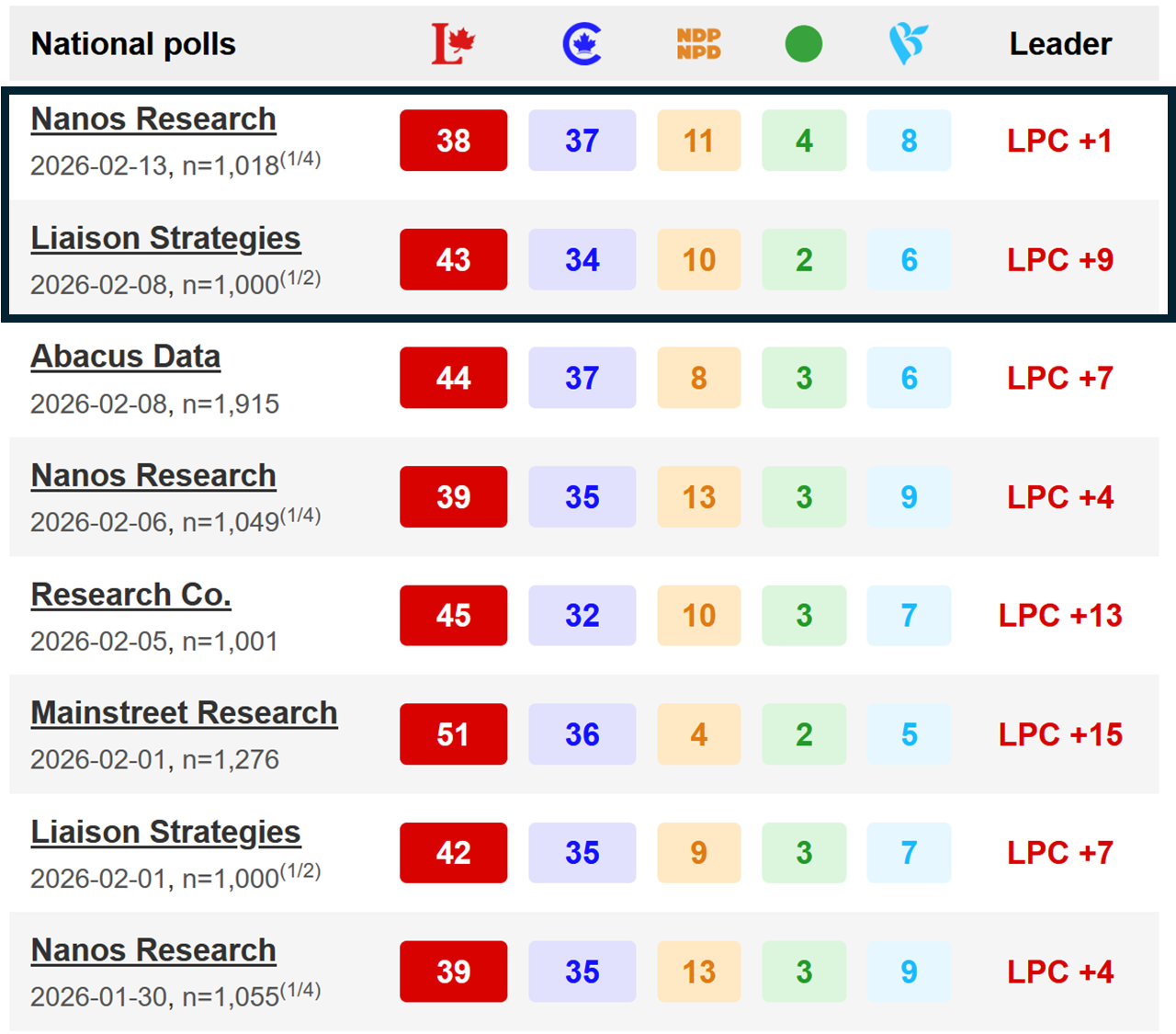
Since the Conservative convention in Calgary in late January (see full table), federal polls have measured Conservative support between 32% and 37% nationally, while Liberal support has ranged from 38% to 45%, with one notable exception: a 51% result from Mainstreet Research.
But the polls were not the main story last week.
Regular readers will know that another MP crossed the floor, leaving the Conservative caucus to join Mark Carney’s Liberals. Matt Jeneroux, MP for Edmonton Riverbend, now gives the Liberals 169 seats — just three shy of the 172-seat majority threshold — with three by-elections expected in the coming months: University—Rosedale (formerly held by Chrystia Freeland), Scarborough Southwest (vacated by Bill Blair), and Terrebonne (where last April’s one-vote result was annulled by the Supreme Court last week).
Based on current numbers, there is little doubt that the two Toronto ridings should remain in Liberal hands. Terrebonne, however, is the ultimate toss-up — and, as last April demonstrated, could well be the seat that determines whether the Liberals reach the majority line.
Yet developments this week may offer the Liberals another route to 172 seats — and, frankly, a more probable one: Rosemont—La Petite-Patrie (RLPP).
This densely populated riding in the heart of Montreal was long a Bloc Québécois stronghold before Jack Layton’s orange wave in 2011. MP Alexandre Boulerice managed to hold on as the NDP receded in Quebec, winning re-election in RLPP in 2015, 2019, 2021, and 2025. The most recent contest, however, was notably tighter: Boulerice’s margin fell from 25 points in 2021 to just 11 points in 2025.
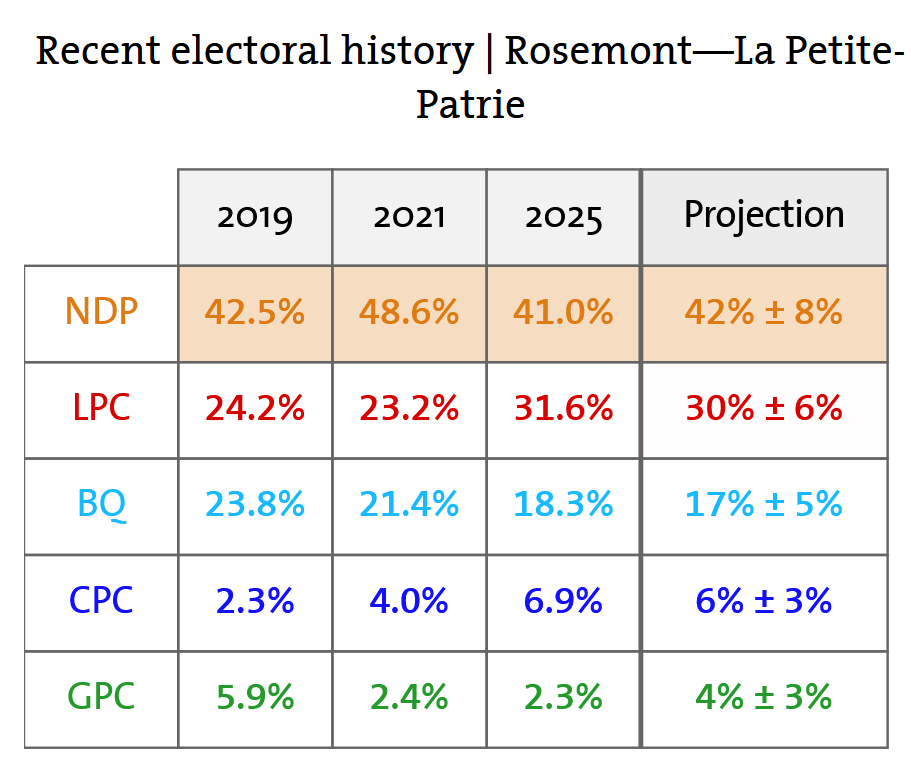
Over the past decade, the Bloc Québécois’ share of the vote in RLPP has steadily declined.
Several reports published last week — and not denied by Boulerice — suggest that he may leave his federal seat to run for Québec solidaire in the next provincial election, in the riding of Gouin, which will be vacated by former QS leader Gabriel Nadeau-Dubois.
Should Boulerice step aside in the coming weeks — potentially after the conclusion of the federal NDP leadership race in late March — the Liberals would likely be the favourites to win RLPP in a by-election.
To be continued.
Before we get to today’s update: Many readers may have seen a Mainstreet Research poll conducted for the Western Standard showing the Liberals trailing the Conservatives by three points in Alberta. The full report and tables have not yet been released. More details soon.
Let’s now get to this week’s 338Canada update.
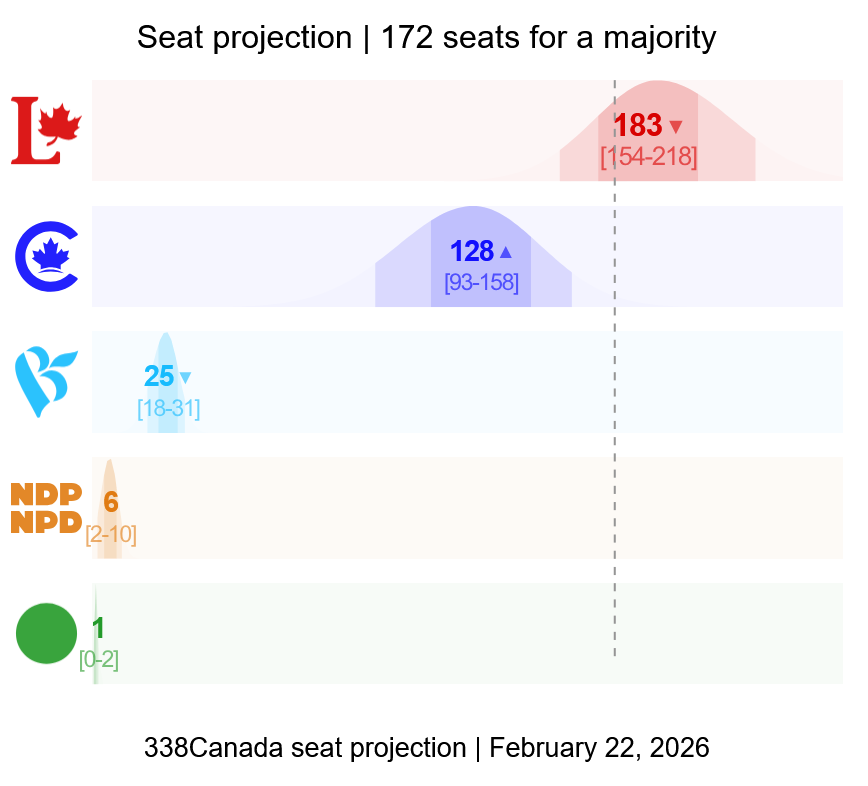
With the polls added to the model this week, overall movement remains limited. The Liberals average 183 seats — 11 above the majority threshold — while the Conservatives stand at 128 seats.
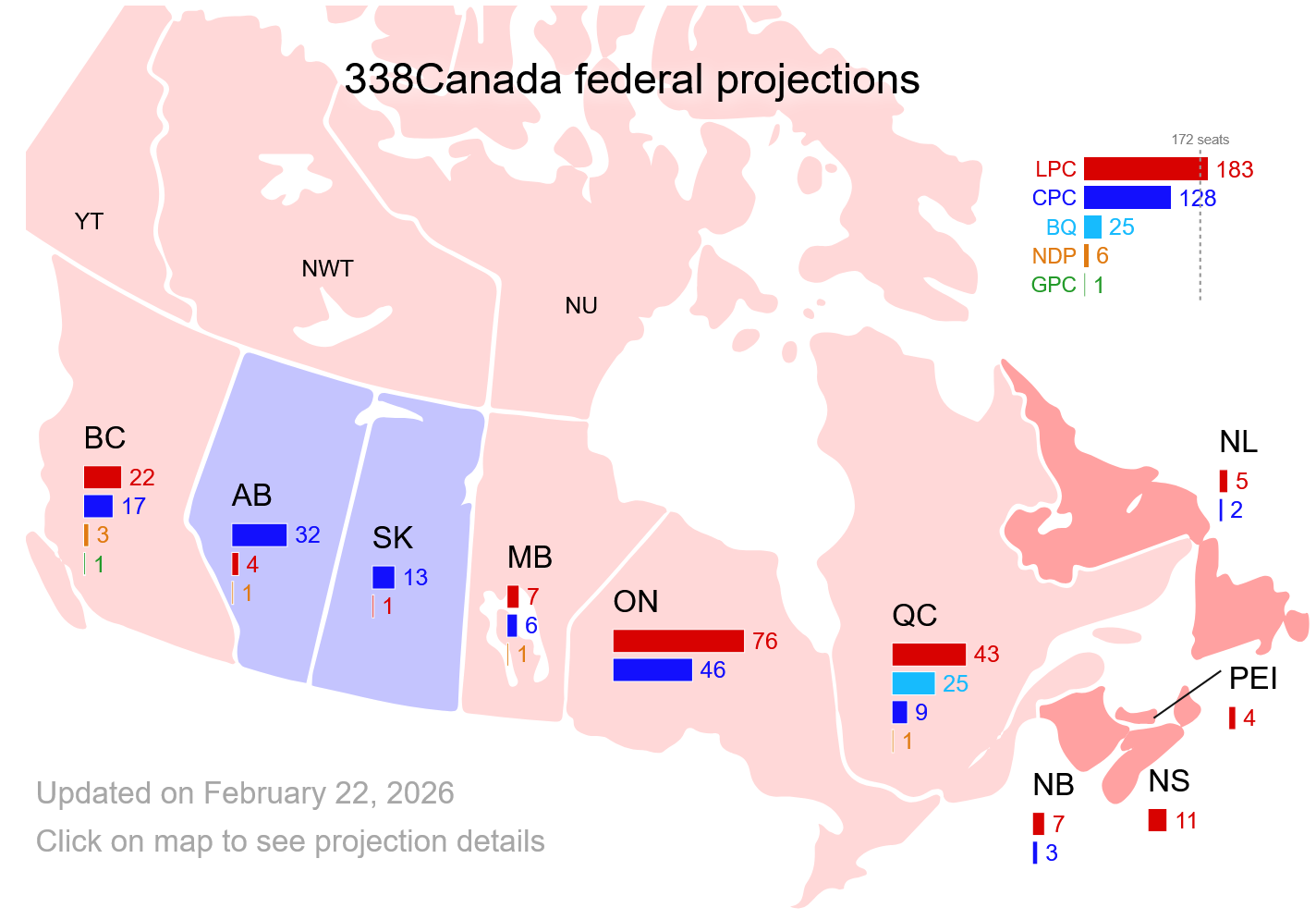
The Bloc Québécois averages 25 seats, with a confidence interval ranging from 18 to 31 seats. The NDP continues to struggle, averaging six seats, with a confidence interval from two to ten.
That will be all for today. Thanks for reading.
More to come this week.
The main federal pages have been fully updated:
Thank you to all 338Canada readers for your continued support. If you value independent, data-driven coverage, please consider subscribing here. 🍁