


🍁Happy Sunday morning, dear 338Canada readers,
Well, well, well… if it isn’t the first significant polling divergence of this 45th Parliament.
The Angus Reid Institute (ARI) released a great deal of interesting data last week. The firm's latest quarterly premier report card was unveiled (more on that below), while its newest federal poll showed a softening of support for Mark Carney’s Liberals — quite the opposite of what Léger measured earlier this month.
Here are the latest releases from active firms on the federal scene:
Let’s begin with the NDP and make our way up.
Every recent pollster except Léger places the NDP between 11% and 15%, a relatively normal range for the party. However, Léger stands alone with the NDP at just 6% — matching the party’s 2025 election result.
For the Conservatives, the range is narrower but still notable: from 29% in the latest Nanos tracker to 36% in the Abacus and ARI polls. Thirty-six percent would still leave the CPC well behind if Liberal support remains north of 40%, but 29% would represent an altogether different level of trouble for the Conservatives in general and for Pierre Poilievre specifically.
As for the Liberals, once again there appears to be a rough consensus on where the governing party stands… were it not for Léger. Liaison, ARI, Nanos, Abacus and Pallas Data all place the Liberals between 40% and 45%, while Léger stands alone with the LPC at 50%.
None of this implies that Léger is wrong and the others are right, or vice-versa. In a universe where the Liberals truly stand around the 45% mark, one should expect the occasional poll at 40% and the occasional poll at 50%. When we plot the latest numbers on the ol’ bullseye chart, the divergence appears much less dramatic.
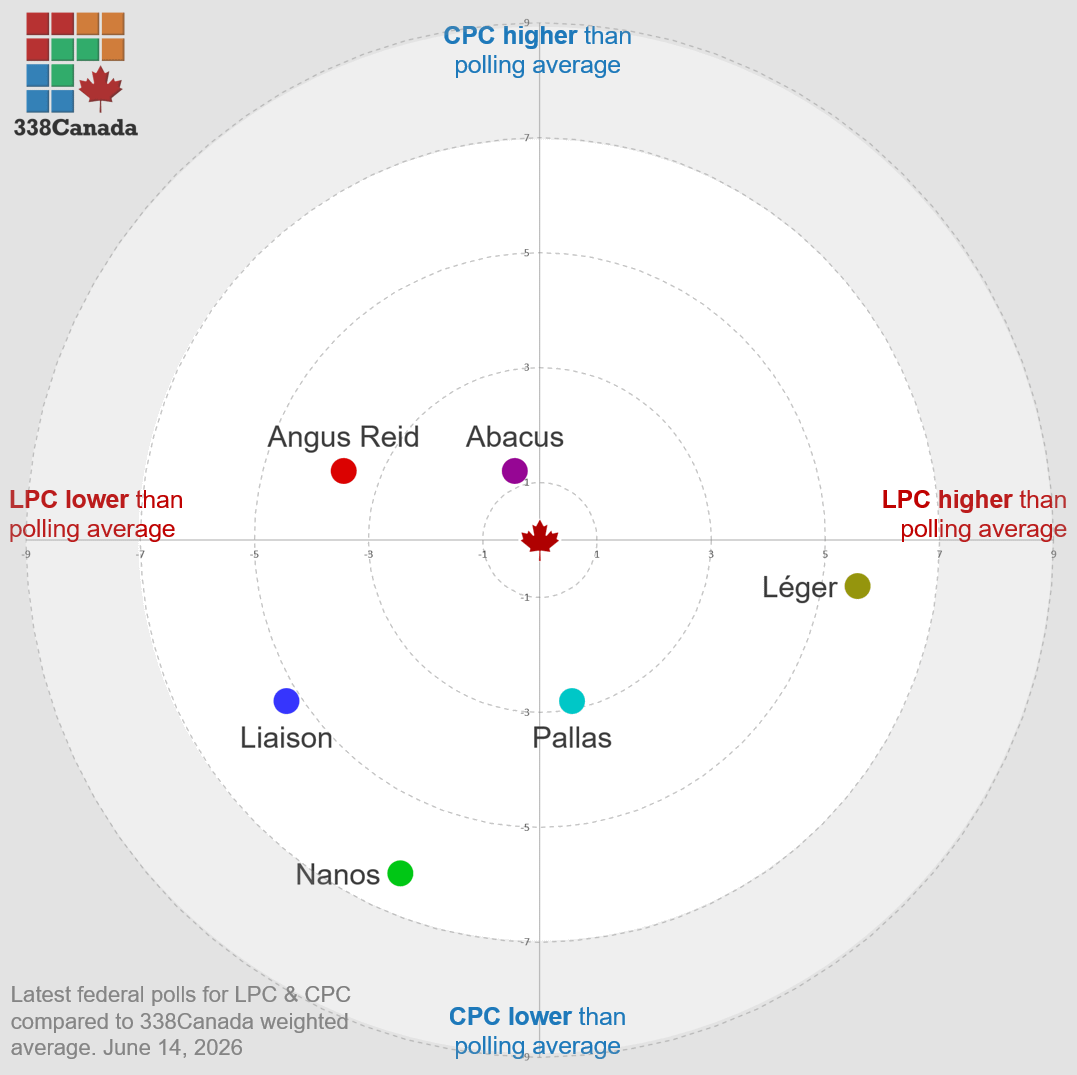
Obviously, it is our electoral system that makes the difference between the Léger and ARI numbers appear so stark. Consider the seat projection estimates below:
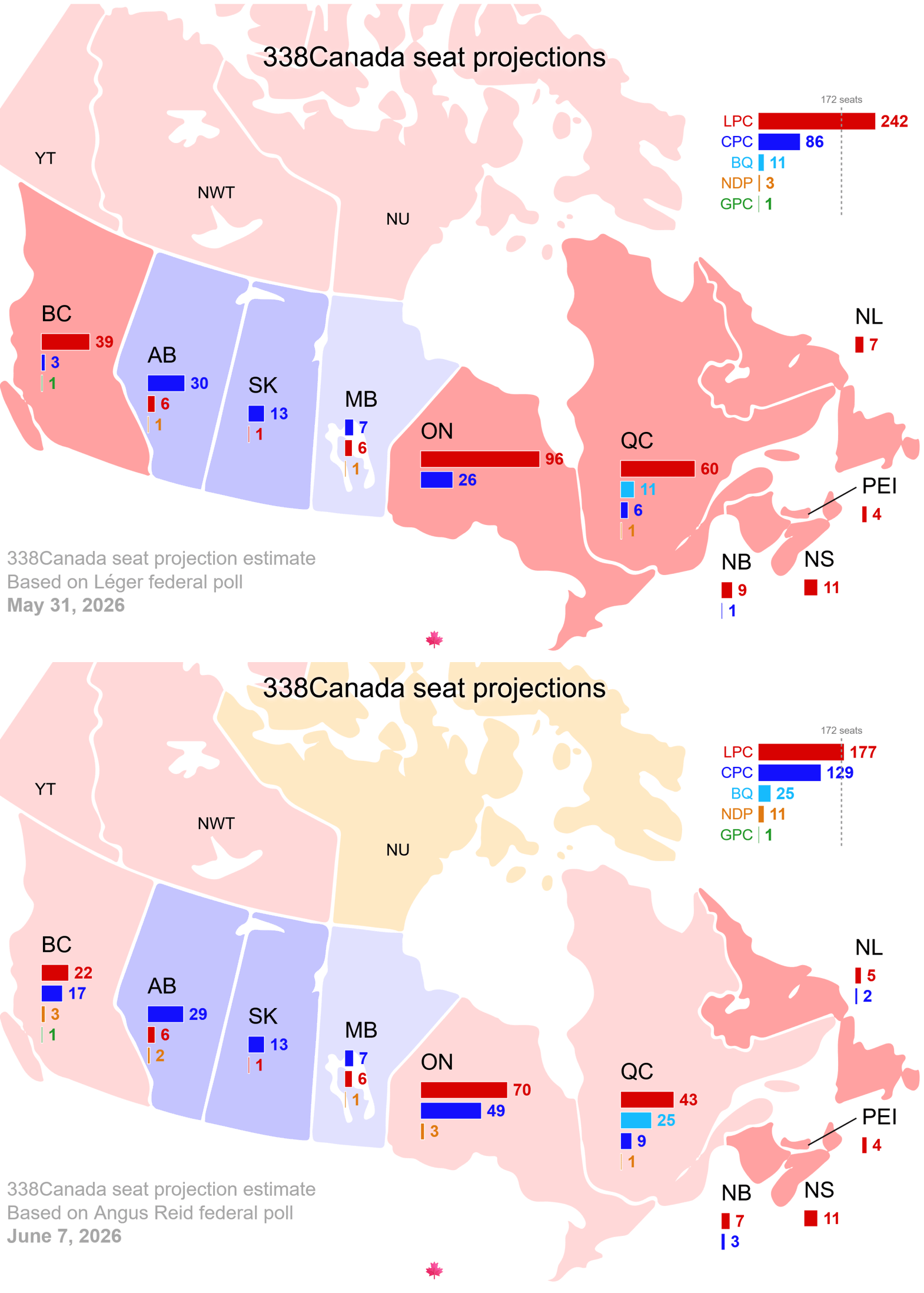
Taken at face value, Léger’s latest numbers would produce the largest majority in Canadian history, with near-sweeps for the Liberals in Atlantic Canada and British Columbia, more than 90 seats in Ontario, and a Liberal takeover of Quebec. This is what a 14-point Liberal lead and a marginal NDP can produce under first-past-the-post.
Using only ARI’s latest numbers, however, the estimate produces a Parliament that resembles the current seat distribution in the House of Commons (floor-crossers included), along with a modest rebound for the NDP.
Single-poll seat projections make for fun thought experiments, but here at 338 HQ we prefer to follow the (weighted) average. So let’s update the federal projection.
📊Enjoy independent, data-driven analysis?
🍁Join thousands of readers supporting 338Canada.
